- How many campaigns were sent
- How many messages were sent
- How many message Opens there were across the entire system
- How many message Clicks there were across the entire system
- How many API calls were made during the day
- And much much more!

Wednesday, January 16, 2008
New System Statistics Page
In conjunction with our "Total Transparency" theme for 2008, we have launched a JangoMail System Statistics page at http://www.jangomail.com/SystemStats.asp that allows you to peer into the internal activity of JangoMail on a daily basis. Every day, learn:


Tuesday, January 15, 2008
New API Method: ImportGroupMembersFromFile
This new method allows you to import Group members from a file that you have previously FTPd. There are two steps to using this method:
1. FTP the file containing the data to ftp://client.jangomail.com. Use your JangoMail username/password to login. Navigate to the folder called "GroupImportsAPI". Place the file there.
2. Call the ImportGroupMembersFromFile method. For the "FileName" parameter, enter the name of the file which you FTPd in Step 1.
This method allows you to import larger sets of data into Groups from any file, whereas the older method ImportGroupMembersFromData has limitations on how much raw data can be passed through in one method call.
1. FTP the file containing the data to ftp://client.jangomail.com. Use your JangoMail username/password to login. Navigate to the folder called "GroupImportsAPI". Place the file there.
2. Call the ImportGroupMembersFromFile method. For the "FileName" parameter, enter the name of the file which you FTPd in Step 1.
This method allows you to import larger sets of data into Groups from any file, whereas the older method ImportGroupMembersFromData has limitations on how much raw data can be passed through in one method call.
Friday, January 11, 2008
New Feature: Email Rendering
We have launched a new feature in beta - an Email Rendering Tool that allows you to see how your e-mail campaign renders in popular e-mail environments like Yahoo! Mail, GMail, AOL Mail, Outlook, and others, before you send to your actual list.
We are currently rendering in the following environments and plan to add more soon:
Here's an example of e-mail rendering from our client, Popcorn Palace (www.popcornpalace.com).
Noteworthy:
JangoMail is the only Email Service Provider to a) develop this feature from scratch and b) provide this feature free-of-charge to all users. A few of our competitors that have this feature license the technology from third parties and charge for it on a per-incident basis.
We are currently rendering in the following environments and plan to add more soon:
- AOL Mail
- GMail
- Hotmail
- Microsoft Outlook 2007
- Mozilla Thunderbird
- Windows Mail
- Yahoo! Mail
Here's an example of e-mail rendering from our client, Popcorn Palace (www.popcornpalace.com).
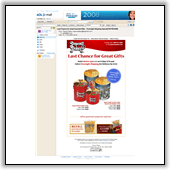 AOL Mail | 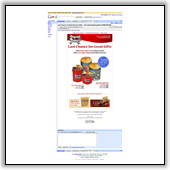 Gmail |
 Microsoft Outlook 2007 | 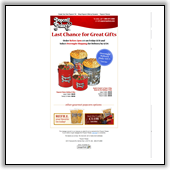 Windows Mail |
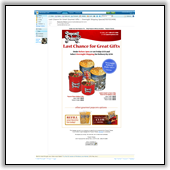 Hotmail | 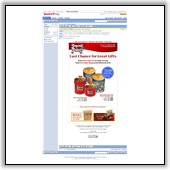 Yahoo! Mail |
 Mozilla Thunderbird | |
Noteworthy:
JangoMail is the only Email Service Provider to a) develop this feature from scratch and b) provide this feature free-of-charge to all users. A few of our competitors that have this feature license the technology from third parties and charge for it on a per-incident basis.
Monday, December 24, 2007
Encouraging the use of DomainKeys
To help ensure optimal deliverability to Yahoo! addresses, we are strongly encouraging all clients who use a non-jangomail.com From Address to ensure that their email messages are signed with DomainKeys. If you send from your @jangomail.com address, your messages are already DomainKeys signed. If you send from your own email address, then you need to setup JangoMail to sign messages for your domain.
Instructions on setting up DomainKeys can be found in this JangoMail DomainKeys Tutorial.
This week we will proactively be sending emails to those clients that send non-DomainKeys signed emails in order to encourage them to set up DomainKeys.
Instructions on setting up DomainKeys can be found in this JangoMail DomainKeys Tutorial.
This week we will proactively be sending emails to those clients that send non-DomainKeys signed emails in order to encourage them to set up DomainKeys.
Saturday, December 22, 2007
JangoMail sets up Comcast Feedback Loop
JangoMail has joined the Comcast Feedback Loop as of this afternoon. Now any Comcast.net users that report e-mailings from JangoMail as spam, will automatically have their e-mail addresses placed on the specific customer account's unsubscribe list. This will improve JangoMail's overall reputation with and deliverability to comcast.net e-mail addresses!
Friday, December 21, 2007
"View as a Web Page" now supports personalization
Many customers have asked for this recently. Now, when you insert a "View as a web page" link into your HTML e-mails, if you're using personalization syntax within the HTML e-mail, that personalization will now properly render in the web page. Previously, the "View as a web page" feature did not show personalization and instead showed the percentage / field name syntax (example: %%FirstName%%).
To insert a "View as a web page" link into your e-mail, you simply insert this code into the body of your HTML message:
Alternatively, if you're using the Enhanced HTML Editor, you can simply click the "Web" button to dynamically insert a "View as a web page" link wherever the cursor is. To learn more about personalization syntax in your e-mail messages, see this tutorial.
To insert a "View as a web page" link into your e-mail, you simply insert this code into the body of your HTML message:
Click <A HREF="http://x.jngo1.net/w.z?***uniqueid****">here</a> to view this e-mail as a web page.
Alternatively, if you're using the Enhanced HTML Editor, you can simply click the "Web" button to dynamically insert a "View as a web page" link wherever the cursor is. To learn more about personalization syntax in your e-mail messages, see this tutorial.
Thursday, December 13, 2007
New Bounce Handling Rules
We have enhanced the way JangoMail handles bounces to improve overall system deliverability. Many of the top ISPs like Hotmail, Yahoo, AOL, GMail, and others have recently mandated that if an e-mail address bounces even once indicating that the mailbox doesn't exist, email marketers should cease mailing to that e-mail address immediately in order to ensure optimal email deliverability.
In conjunction with this, if a Bounce indicates that the mailbox does not exist, JangoMail will stop sending to this address from your account regardless of what numeric setting you have specified under My Options --> Bounce Handling.
However, if a Bounce indicates a temporary failure for that email address, then the numeric setting under My Options --> Bounce Handling will still apply.
Additionally the new Bounce handling mechanism will allow you to see the Bounce reasons for the life of your account rather than just for 7 days, once the enhanced Reporting module is in place (about six weeks from now).
Here are some examples to illustrate the new Bounce handling:
A bounce with a message like:
smtp;550 4.2.1 mailbox temporarily disabled: akidd4@verizon.net
is a temporary failure, and the setting under My Options --> Bounce Handling would apply.
A bounce with a message like:
smtp;550 No such user here
indicates that the mailbox does not exist at all, so a single bounce would prevent JangoMail from sending to this address in the future.
In conjunction with this, if a Bounce indicates that the mailbox does not exist, JangoMail will stop sending to this address from your account regardless of what numeric setting you have specified under My Options --> Bounce Handling.
However, if a Bounce indicates a temporary failure for that email address, then the numeric setting under My Options --> Bounce Handling will still apply.
Additionally the new Bounce handling mechanism will allow you to see the Bounce reasons for the life of your account rather than just for 7 days, once the enhanced Reporting module is in place (about six weeks from now).
Here are some examples to illustrate the new Bounce handling:
A bounce with a message like:
smtp;550 4.2.1 mailbox temporarily disabled: akidd4@verizon.net
is a temporary failure, and the setting under My Options --> Bounce Handling would apply.
A bounce with a message like:
smtp;550
indicates that the mailbox does not exist at all, so a single bounce would prevent JangoMail from sending to this address in the future.
Thursday, November 08, 2007
New Feature: Blocking sign-up form spam by specifying an Exclusive Referrer URL
In the past, we outlined a method to block sign-up form spam by changing the encoding type of your sign-up form. That method may be found here.
This method will not work, however, in cases where the spambot isn't coming through your web site's form but rather by avoiding a form alltogether and programatically doing a FORM POST to our form processor file, http://www.jangomail.com/APPLICATION/PGSF2.asp or http://www.jangomail.com/APPLICATION/PGSF2ENC.asp.
To defend against this new technique for propagating sign-up form spam, you can now specify an exclusive Referrer URL from where the signup form must originate. You can now assign a specific exclusive Referrer URL to a particular JangoMail Group. Then, if a form signup comes from a destination other than the exclusive Referrer URL you have designated, the signup will not be processed.
Currently there is no interface within JangoMail for you to be able to set an exclusive Referrer URL yourself for an e-mail Group. Currently, our support team must do this for you administratively should you wish to take advantage of this setting.
This method will not work, however, in cases where the spambot isn't coming through your web site's form but rather by avoiding a form alltogether and programatically doing a FORM POST to our form processor file, http://www.jangomail.com/APPLICATION/PGSF2.asp or http://www.jangomail.com/APPLICATION/PGSF2ENC.asp.
To defend against this new technique for propagating sign-up form spam, you can now specify an exclusive Referrer URL from where the signup form must originate. You can now assign a specific exclusive Referrer URL to a particular JangoMail Group. Then, if a form signup comes from a destination other than the exclusive Referrer URL you have designated, the signup will not be processed.
Currently there is no interface within JangoMail for you to be able to set an exclusive Referrer URL yourself for an e-mail Group. Currently, our support team must do this for you administratively should you wish to take advantage of this setting.
Tuesday, November 06, 2007
New Feature: Generating a Plain Text Message Automatically at Run-Time
You can now have JangoMail automatically generate a Plain Text version of your e-mail message, based on your HTML version, at the time the email message is sent (run-time). To do this, set your Plain Text message to the word "auto-generate".
There has always been the "Set Plain Text Automatically" button underneath the Plain Text Message field on the Send Email page. This button examines your HTML message and generates a Plain Text Message for you right before your eyes. However, there may be situations where you don't want to generate the Plain Text message right away but rather have the Plain Text message generated at the time the email message is actually sent.
There are 3 scenarios where this feature will be advantageous.
Scenario 1 - Embedded URLs
If you are using Embedded URLs within your e-mail message, your HTML message might look like:
<html>
<p>
Hello there. Below you will find today's mutual fund prices:
</p>
[%%http://www.MutualFundCompany.com/Prices.aspx%%]
<p>
Thank you for investing in our mutual funds.
</p>
</html>
By setting the Plain Text Message field to "auto-generate", the following will take place at the time of e-mail sending:
- JangoMail will retrieve the HTML content from the specified URL.
- JangoMail will insert the HTML content into the HTML message.
- JangoMail will generate a Plain Text version of the e-mail message based on the complete HTML message.
In this scenario, if you do NOT set the Plain Text field to "auto-generate", but instead use the "Set Plain Text Automatically" button on the Send E-mail page, the following will take place:
- The Plain Text version will look like this:
Hello there. Below you will find today's mutual fund prices.
[%%http://www.MutualFundCompany.com/Prices.aspx%%]
Thank you for investing in our mutual funds.
- When JangoMail retrieves the HTML content from the URL, the Plain Text message will now contain HTML code, and we don't want that to happen!
Scenario 2 - Using the Web Service/API
When calling any of these methods:
SendMassEmail
SendMassEmailPrevious
SendMassEmailRaw
Setting the MessagePlain input parameter to "auto-generate" will allow JangoMail to generate a Plain Text version of your HTML e-mail for you automatically. The "Set Plain Text Automatically" button that is available in the JangoMail web interface is not available when using the API, so for any automatic conversion to take place, the MessagePlain input parameter must be set to "auto-generate". Otherwise, you would have to manually input a Plain Text version of your message.
Scenario 3 - Using Conditional Logic Statements
When using VBScript conditional logic statements in your e-mail message, the line spacing of plain text messages can be altered based on where you place your lines of code. These spacing issues can be avoided by setting the Plain Text field to "auto-generate" rather than placing actual conditional logic statements within the Plain Text field.
Feature Enhancement: Using wildcards when filtering a Group based on clicks
When filtering a Group by those that have clicked on a particular URL, you can now use wildcards in the URL.
For example, in the Advanced Filter Mode, the filter criteria based on a clicked URL would normally look like:
emailaddress in (##clicked-http://www.jangomail.com/pricing.asp##)
but now you can filter for anyone that has clicked on any URL that contains jangomail.com:
emailaddress in (##clicked-*jangomail.com*##)
This feature was added at the request of an evaluating customer.
For example, in the Advanced Filter Mode, the filter criteria based on a clicked URL would normally look like:
emailaddress in (##clicked-http://www.jangomail.com/pricing.asp##)
but now you can filter for anyone that has clicked on any URL that contains jangomail.com:
emailaddress in (##clicked-*jangomail.com*##)
This feature was added at the request of an evaluating customer.
Sunday, November 04, 2007
Bug Fix: Sending a Campaign where Recipient Group has been DELETED
We have fixed a bug tonight that caused a campaign to completely fail if one of the recipient Groups had been deleted between the time of creating the campaign and the time of campaign sending.
NOW, if a campaign includes a Group that has been deleted, the campaign will still send to all other present Groups and will gracefully skip over the Group that has been deleted.
NOW, if a campaign includes a Group that has been deleted, the campaign will still send to all other present Groups and will gracefully skip over the Group that has been deleted.
New Feature: Large Text Fields in Groups
When managing fields in your Groups, you now have the ability to create a special type of field which allows for storage of a large amount of text data.
Previously:
Previously:
- Fields in Groups could store a maximum of 8,000 characters
- The total amount of personalization amongst all fields within any single e-mail campaign could not exceed 7,900 characters.
- A "large text" field in a Group can now store virtually an unlimited number of characters.
- There is no limit to the amount of personalization within an e-mail campaign.
- Within your Group, click on "Modify Fields in Group".
- You can add a new Group field that stores large text by choosing a name for the field and checking the box labeled "Will store large text data".
- You can convert an existing field by clicking the "Convert" button next to the existing field.
- If using the API, use the AddGroupField_Big method instead of the regular AddGroupField.
Tuesday, October 30, 2007
New API Methods to Retrieve Unsubscribes
We have three new API methods that allow you to pull the entire list of unsubscribed addresses and their dates, from an account:
Reports_GetUnsubscribesByCampaign_DataSet
Retrieves list of unsubscribed addresses for a particular mass e-mail campaign. Returns a .NET DataSet. Reports_GetUnsubscribesByCampaign_String
Retrieves list of unsubscribed addresses for a particular mass e-mail campaign. Returns a string. Reports_GetUnsubscribesByCampaign_XML
Retrieves list of unsubscribed addresses for a particular mass e-mail campaign. Returns an XML document.
Retrieves list of unsubscribed addresses for a particular mass e-mail campaign. Returns a .NET DataSet.
Retrieves list of unsubscribed addresses for a particular mass e-mail campaign. Returns a string.
Retrieves list of unsubscribed addresses for a particular mass e-mail campaign. Returns an XML document.
Monday, October 29, 2007
Bug Fix: Activity Tracking Reports with Merged Groups
Previously, when exporting an Activity Tracking report that was also merged with Group data, the report would fail to export to a CSV file, and the CSV file link would therefore fail to be sent via email.
This issue has now been corrected.
This issue has now been corrected.
Wednesday, October 10, 2007
Awesome Enhancements to JangoMail Groups
Over the last few months, we have been busy architecting a brand new storage system to house JangoMail Groups. That project is now complete, and this week we're converting all JangoMail Groups over to our new system. To help you delineate which Groups have been converted and which haven't, we have temporarily placed an * symbol next to each Group that has been converted. You will see this when you click on the Groups and Email Addresses tab and view your Group listing.
Additionally, all new Groups created going forward will be using the new architecture.
The benefits of our new Groups architecture include:
1. The ability to have up to 240 fields in a Group with no performance degradation. Previously, you were limted to around 40, before sending to and segmentation on Groups would underperform.
2. Much faster segmentation of Groups when using the Filter and Send feature.
3. The Delete All Members button will now work almost instantaneously. Previously, this could take several minutes with large Groups.
4. The ability to search your Groups. You can search one specific Group or you can search all of your Groups at once. You can search on any field in a Group (such as E-mail Address, or First Name, or Company Name, for example), and you can search based on partially matching expressions. So if you want to find e-mail addresses across all Groups that contain "yahoo" in them, now you can!
5. Much faster Group imports.
Additionally, all new Groups created going forward will be using the new architecture.
The benefits of our new Groups architecture include:
1. The ability to have up to 240 fields in a Group with no performance degradation. Previously, you were limted to around 40, before sending to and segmentation on Groups would underperform.
2. Much faster segmentation of Groups when using the Filter and Send feature.
3. The Delete All Members button will now work almost instantaneously. Previously, this could take several minutes with large Groups.
4. The ability to search your Groups. You can search one specific Group or you can search all of your Groups at once. You can search on any field in a Group (such as E-mail Address, or First Name, or Company Name, for example), and you can search based on partially matching expressions. So if you want to find e-mail addresses across all Groups that contain "yahoo" in them, now you can!
5. Much faster Group imports.
Tuesday, October 09, 2007
New API methods to edit a Group member
We recently added the following two API methods, which some customers are already using to edit a Group member:
Groups_EditMember_ByAddress
Updates a field for a group member. Returns a string Groups_EditMember_ByID
Updates a field for a Group member. Returns a string
As the two methods suggest, you can edit a Group member based on the member's e-mail address or the member's numeric ID.
For more information on our API, please see http://api.jangomail.com.
Updates a field for a group member. Returns a string
Updates a field for a Group member. Returns a string
As the two methods suggest, you can edit a Group member based on the member's e-mail address or the member's numeric ID.
For more information on our API, please see http://api.jangomail.com.
Monday, July 16, 2007
New Feature for Group Sign-Up Forms
You can now add a field to your Group named ReferrerURL, and if this field is present, when a new member joins your Group via a Web Site Signup Form, the URL of the page of the form will be captured and stored in this field.
This can be useful if you have multiple Group Web Site Signup Forms on multiple pages of your web site, and you wish to track from what pages within your web site most people are signing up.
This can be useful if you have multiple Group Web Site Signup Forms on multiple pages of your web site, and you wish to track from what pages within your web site most people are signing up.
Friday, July 13, 2007
Scrub processing is now multi-threaded
We have made Group scrubs multi-threaded, which means our system can now process up to ten Group scrubs at one time. This will greatly improve the speed at which Group scrubs are processed. We also have a built-in safety to ensure that no one single user can occupy more than three Scrub threads at the same time.
Update: Email Campaigns will no longer wait on Scrub Jobs
Previously, an outgoing e-mail campaign would be held up if the Group to which it was going had a pending Scrub job on it. We have now modified our code so that campaigns will go out, even if there is a pending Scrub on the E-mail Group to whom the campaign is going.
Wednesday, July 11, 2007
Bug Fix: Conditional Logic and the Enhanced HTML Editor
When using "greater than" and "less than" symbols with the Enhanced HTML Editor, the symbols would be replaced with "gt;" and "lt;" notations, as is proper HTML. This would then prevent conditional logic/VBSsript within the Body of the e-mail campaign from running properly.
We have fixed this bug by replacing the "gt;" and "lt;" notations with the proper "greater than" and "less than" symbols before the scripting engine processes the Body of the e-mail message.
We have fixed this bug by replacing the "gt;" and "lt;" notations with the proper "greater than" and "less than" symbols before the scripting engine processes the Body of the e-mail message.
Subscribe to:
Posts (Atom)