JangoMail has added the ability to use personalization coding in the BCC field as you compose your messages.
The BCC feature allows you to specify an address that will receive a blind (address not visible to the email's direct recipient) copy of the message as it is sent out. It is found under Advanced Options as you compose in the Send E-mail tab.
For example, you send a personalized message that starts: Dear Kim, Dear Joe, Dear Susie, etc. Kim, Joe, and Susie each receive their individual emails, showing the appropriate personalization. At the same time, the address given in the BCC field also receives 3 emails: copies of the separate messages for Kim, Joe, and Susie.
Previously, you could only specify a single address to receive the BCC. This was often used for businesses with compliance needs that required an archive of messages sent.
Now, you can use our personalization coding to send the BCC email to an address stored in each record in your database. For example, addresses might have a particular representative assigned to them. The email can be "signed" from the representative in the message body:
Regards,
%%repname%%
%%repemail%%
Now, these representatives can also receive a behind-the-scenes copy of what "they" sent out via the JangoMail system, so that they won't be surprised with direct responses from their clients. If this data is stored in a field called "repemail" for each record, just put %%repemail%% in for the BCC.
Note: When using the BCC feature, JangoMail is generating two emails for every one recipient address. This will double your email sending volume for pricing purposes.

Friday, October 10, 2008
Thursday, October 09, 2008
New Feature: Specify an SMS Text Message
JangoMail has added an SMS Text Message feature to our Messages composition page. Now you can send a specific message to an SMS address, instead of the HTML or Plain Text message types. Be courteous to your recipients receiving messages by text and build a message tailored to them.
You will find the new field on the Messages composition screen, under the SMS tab. Specify a message here for any text users. If an email address is in one of the listed SMS email gateway domains, then this SMS Text Message will be sent from your JangoMail account instead of the standard HTML/Plain Text multipart message.

If the SMS Text Message field is not set, and a recipient's domain is an SMS email gateway domain, then the email message will be assembled as normal, including the HTML Message, Plain Text Message, and any attachments.
A full list of SMS email gateways is available at http://en.wikipedia.org/wiki/SMS_gateway.
The following properties are ignored when an email message to an SMS email gateway is assembled:
You will find the new field on the Messages composition screen, under the SMS tab. Specify a message here for any text users. If an email address is in one of the listed SMS email gateway domains, then this SMS Text Message will be sent from your JangoMail account instead of the standard HTML/Plain Text multipart message.

If the SMS Text Message field is not set, and a recipient's domain is an SMS email gateway domain, then the email message will be assembled as normal, including the HTML Message, Plain Text Message, and any attachments.
A full list of SMS email gateways is available at http://en.wikipedia.org/wiki/SMS_gateway.
The following properties are ignored when an email message to an SMS email gateway is assembled:
- Open Tracking
- Click Tracking
- Wrapping
- Plain Text Message
- HTML Message
- Attachments
- Triggers


Friday, October 03, 2008
New Feature: Calendar/Time controls added to Send E-mail page
JangoMail has made it easier to get the format right when entering date/time information for scheduling emails to be sent in the future or on a recurring schedule.
We have introduced new calendar and time controls for these fields to help you get it right the first time.
How do you use the new tools? Look to the right of the scheduling fields for the calendar and clock symbols.

Click on the calendar to set the date.

Now, click on the clock to set the desired time.

You'll wind up with the right format each time.

We have introduced new calendar and time controls for these fields to help you get it right the first time.
How do you use the new tools? Look to the right of the scheduling fields for the calendar and clock symbols.

Click on the calendar to set the date.

Now, click on the clock to set the desired time.

You'll wind up with the right format each time.

Thursday, October 02, 2008
New API Methods and Enhancements
JangoMail has launched some new API methods, and some enhancements to earlier methods.
Retrieve Complaint Data
JangoMail now allows you to pull the data behind the "Complaints" column of your General Job Statistics report via the API. This reflects addresses that have used their "this is spam" reporting tools via their ISP, which JangoMail receives via feedback loop.
JangoMail has a new setting to prevent duplicates from being added to a Group. With the API, the AddGroupMember and EditGroupMember methods reflect this change as well. Both will now throw exceptions if the Group is set to disallow duplicates and you:
Retrieve Complaint Data
JangoMail now allows you to pull the data behind the "Complaints" column of your General Job Statistics report via the API. This reflects addresses that have used their "this is spam" reporting tools via their ISP, which JangoMail receives via feedback loop.
- Reports_GetComplaintsByCampaign_Dataset retrieves list of complaints for the given Job ID. Returns a .NET DataSet.
- Reports_GetComplaintsByCampaign_String retrieves list of complaints for the given Job ID. Returns a String.
- Reports_GetComplaintsByCampaign_XML retrieves list of complaints for the given Job ID. Returns an XML document.
Check Job/Campaign Status
Once you send, your campaign goes through three stages:
- Preprocessing -- where the message is prepared for sending, removing duplicates, bounces, unsubscribes, etc. prior to sending.
- Sending -- where the message is personalized and launched from our network of senders.
- Complete -- where your campaign has fully completed sending.
These states are shown in the JangoMail interface under Reporting, and you can now confirm the current status of any campaign by API as well.
GetMassEmailStatus returns the current status for the given job/campaign ("Preprocessing", "Sending", or "Complete").
Enhancements to the "Send..." Methods
The CustomCampaignID can now be specified in the "Options" parameter of the "Send" methods (SendMassEmail, SendMassEmailPrevious, SendMassEmailPrevious2, SendMassEmailRaw). For example, Options can now include the following parameter: CustomCampaignID=FinalMailer.
Attachments will now validate during sending. This will alert you if you specify an attachment in the "Options" parameter that does not exist on the server. Previously, such a campaign would still go through, but missing the attachment, and the method would return a SUCCESS message. Now if the attachment doesn't exist, an exception will be thrown and no campaign will be sent or saved.
Enhancements to AddGroupMember and EditGroupMemberJangoMail has a new setting to prevent duplicates from being added to a Group. With the API, the AddGroupMember and EditGroupMember methods reflect this change as well. Both will now throw exceptions if the Group is set to disallow duplicates and you:
- attempt to either add an already existent address, or
- edit an address such that it would match an already existent address.
For the full web-based reference on all available methods and their signatures, including the new methods and enhancements, click here.
New Feature: Prevent Duplicates in Groups
JangoMail now allows you to prevent duplicate addresses from being added to a Group.
To turn this setting ON, go to Groups and E-mail Addresses and select your Group. Click the "Enable/Disable Duplicate Members" button in the right hand pane.

With this setting enabled, if you attempt to add an address to a Group that already contains that address, it will prevent the new entry. The method of adding a Group member will not affect this setting.
Manual entries will display an error, and imports will skip addresses already in the Group. If you are using a web site sign up form, the user will get an error if they are already in the Group, preventing a second entry for that email address.
Note the difference between this and a Scrub (Scrub Group Members), for a Scrub does not prevent duplicates from being added--it just clears duplicate entries (by email address) when executed.
Note: If you enable this setting on a Group that already has duplicates, the existing duplicates are NOT deleted unless you run a Scrub.
To turn this setting ON, go to Groups and E-mail Addresses and select your Group. Click the "Enable/Disable Duplicate Members" button in the right hand pane.

With this setting enabled, if you attempt to add an address to a Group that already contains that address, it will prevent the new entry. The method of adding a Group member will not affect this setting.
Manual entries will display an error, and imports will skip addresses already in the Group. If you are using a web site sign up form, the user will get an error if they are already in the Group, preventing a second entry for that email address.
Note the difference between this and a Scrub (Scrub Group Members), for a Scrub does not prevent duplicates from being added--it just clears duplicate entries (by email address) when executed.
Note: If you enable this setting on a Group that already has duplicates, the existing duplicates are NOT deleted unless you run a Scrub.
Monday, September 29, 2008
New Feature: Creating Multiple Logins for Your Account
JangoMail users now have the option to create alternate login credentials (username and password) for their accounts.
Creating additional logins will allow additional people access to the same account. Creating additional logins does NOT create new JangoMail accounts, and all logins have the same permissions as the main username/password on an account.
You may find this useful if you have multiple people accessing the same account. With different logins assigned to each employee,if one employee leaves, that one login can simply be deleted without affecting the others using the account.
There are a few limits to these logins. The additional logins do not have API access, the ability to initiate mass emails through an external email client, or the ability to FTP to the JangoMail server. Only the administrator's login can utilize these functions.
How do I get started?
Login with the current username and password, and go to the My Account section in the upper right of the interface.

Select the Other Logins tab.
Creating additional logins will allow additional people access to the same account. Creating additional logins does NOT create new JangoMail accounts, and all logins have the same permissions as the main username/password on an account.
You may find this useful if you have multiple people accessing the same account. With different logins assigned to each employee,if one employee leaves, that one login can simply be deleted without affecting the others using the account.
There are a few limits to these logins. The additional logins do not have API access, the ability to initiate mass emails through an external email client, or the ability to FTP to the JangoMail server. Only the administrator's login can utilize these functions.
How do I get started?
Login with the current username and password, and go to the My Account section in the upper right of the interface.

Select the Other Logins tab.


Friday, September 26, 2008
Enhancement to Reporting: Filter by CampaignID
We have now expanded the General Job Statistics Report's filtering abilities, making it easier for you to locate a specific email campaign. Now, you can use the CampaignID filter to locate specific jobs quickly by searching for the campaign's unique numeric identifier.


Bug Fix: Foreign Characters and Personalization
We have now deployed fixes for two bugs related to handling foreign characters in personalization.
Using the API for "on the fly" personalization
Using our ability to do "on the fly" personalization with the API in the SendMassEmail method, we were not properly encoding personalization when it involved a non-English character set.
With this correction, you can now submit personalization field values that DO use the non-English character set, provided that it is specified in the CharacterSet option.
Now, your Options attribute can contain parameters like:
Options=
ToOtherRowDelimiter=¦,ToOtherColDelimiter=c,
ToOtherFieldNames=FirstName¦LastName¦EmailAddress¦
Headline,CharacterSet=UTF-8
This would allow you to then use the following to create a merged message with non-English characters:
ToOther=
John,Smith,john@smith.com,揭秘神舟七号飞船气闸舱¦David,Gary,david@gary.com,揭秘神舟七号飞船气闸舱¦Sheila,Panther,sheila@panther.com,揭秘神舟七号飞船气闸舱
Subject=
Hello %%FirstName%%Message=Hello %%FirstName%% %%LastName%% -- today's headline is %%Headline%%
Using foreign characters in stored Group data
When storing data in a JangoMail Group, foreign characters inserted into a group member's field previously had turned into neutral placeholders when saved. Now JangoMail can correctly store foreign characters in Groups too and use that for personalization.
Using the API for "on the fly" personalization
Using our ability to do "on the fly" personalization with the API in the SendMassEmail method, we were not properly encoding personalization when it involved a non-English character set.
With this correction, you can now submit personalization field values that DO use the non-English character set, provided that it is specified in the CharacterSet option.
Now, your Options attribute can contain parameters like:
Options=
ToOtherRowDelimiter=¦,ToOtherColDelimiter=c,
ToOtherFieldNames=FirstName¦LastName¦EmailAddress¦
Headline,CharacterSet=UTF-8
This would allow you to then use the following to create a merged message with non-English characters:
ToOther=
John,Smith,john@smith.com,揭秘神舟七号飞船气闸舱¦David,Gary,david@gary.com,揭秘神舟七号飞船气闸舱¦Sheila,Panther,sheila@panther.com,揭秘神舟七号飞船气闸舱
Subject=
Hello %%FirstName%%Message=Hello %%FirstName%% %%LastName%% -- today's headline is %%Headline%%
Using foreign characters in stored Group data
When storing data in a JangoMail Group, foreign characters inserted into a group member's field previously had turned into neutral placeholders when saved. Now JangoMail can correctly store foreign characters in Groups too and use that for personalization.
Tuesday, August 26, 2008
Update to ASP script file for web servers
This notice applies to you if you use JangoMail's "Connect to Internet Web Site Database" feature to pull email address data in real-time from your web site's database.
We've updated the web server script file that is used to allow JangoMail to connect to your web / database platform. This update applies to those customers using one of these three platforms:
- Active Server Page web site / Any ODBC compliant database
- Active Server Page web site / Microsoft SQL Server Database
- Active Server Page web site / Microsoft Access Database
This update does not apply to the PHP / MySQL platform, because the w_4.php file has never used the EnDeCrypt algorithm used in the w_x.asp files.
What is the update?
The update eliminates the EnDeCrypt encryption algorithm that was previously used in the w_x.asp files. The EnDeCrypt algorithm present in the w_x.asp files is an outdated encryption/decryption mechanism that we have deprecated in favor of using standard SSL (Secure Sockets Layer) security with the https protocol.
If you retrieve the appropriate w_x.asp file now from the Extract From My Database tab of JangoMail, the new w_x.asp file will no longer contain the lines of code that perform the decryption. If you have made your own custom modifications to the script file on your web server, you can update the file manually. Or, you can retrieve the updated file from JangoMail directly.
After the updated file is in place, you must click a button at the top of the Extract From My Database tab which will tell JangoMail to stop encrypting data using the EnDeCrypt algorithm when passing information to your web server.
To update your w_x.asp file manually:
- Comment out or delete the lines that perform the EnDeCrypt decryption.
- Deleting the RC4Initialize subroutine and EnDeCrypt function.
- Comment out or delete the two array declarations, "Dim sbox(255)" and "Dim key(255)"
- Click the button that appears at the top of the Extract From My Database page to update your JangoMail account so that data is no longer encrypted with EnDeCrypt before it's passed to your web server.
To retrieve the updated w_x.asp file from JangoMail:
- Login to your JangoMail account.
- Click the Extract From My Database tab.
- Click "retrieve the web server file" and follow the directions to download the appropriate file.
- Click the button that appears at the top of the Extract From My Database page to update your JangoMail account so that data is no longer encrypted with EnDeCrypt before it's passed to your web server.
Do I have to update my w_x.asp file?
We highly recommend that you do the update as soon as possible. The old versions of w_x.asp, with the EnDeCrypt mechanism, will continue to work through the end of the year. In early 2009, the option to use a w_x.asp file with the EnDeCrypt routines will no longer exist.
One final note:
There is a benefit to updating if you maintain multiple JangoMail accounts. The old w_x.asp files, with the EnDeCrypt mechanism, made use of a private key that was hard coded inside the routines, and a private key was unique to a single JangoMail account. Once you update to the new w_x.asp files, there will be no hard coded key, and this will allow the same version of the w_x.asp file to be used with multiple JangoMail accounts.
Monday, August 18, 2008
Feature Update: Link JangoMail to Multiple Salesforce Accounts
We have expanded our Salesforce integration so that you can now connect one JangoMail account to multiple Salesforce accounts.
Now, if you have multiple Sales Agents that use their own Salesforce accounts, they can all use the same JangoMail account for sending.
How do you set this up?
Now, if you have multiple Sales Agents that use their own Salesforce accounts, they can all use the same JangoMail account for sending.
How do you set this up?
- From inside Salesforce, click the "JangoMail" tab. If you login to an existing JangoMail account, then the Salesforce account from which you logged in will be ADDED to that JangoMail account's list of linked Salesforce accounts.
- Go to My Options --> Salesforce --> Account Settings. Now instead of the previous single line text field that stored a single Salesforce User ID, there is a text box that can store multiple Salesforce User IDs. Type in any additional IDs here, each on a separate line.


This multiple connection only works one direction, however. You currently CANNOT have multiple JangoMail accounts linked to the same Salesforce account. A Salesforce account can only be linked to one JangoMail account, but a JangoMail account can be linked to multiple Salesforce accounts.

Wednesday, August 13, 2008
Image Library Now Accepts .MOV Files
JangoMail has expanded the Image Library so that you can now upload Quicktime .MOV files. Once stored, you may create links in your messages that reference the hosted files much as you would a PDF or other non-image file.
JPG and GIF files remain the only image file types that are recognized by the HTML Editor's Insert Image function because they are the file types that are viewable across most HTML-capable e-mail clients.
Other file types are accepted into the library for hosting. Our tutorial on linking to hosted files (PDFs and others) can be downloaded here.
JPG and GIF files remain the only image file types that are recognized by the HTML Editor's Insert Image function because they are the file types that are viewable across most HTML-capable e-mail clients.
Other file types are accepted into the library for hosting. Our tutorial on linking to hosted files (PDFs and others) can be downloaded here.
Bug Fix: JangoMail for Salesforce Personalization Fields
JangoMail has corrected field misalignment that was occurring when sending to campaigns with members from both leads and contacts.
The error resulted in problems with personalization fields not properly matching during sending.
This is now fixed. As a result of the change we have made, some personalization syntax has changed slightly. Before, when you pulled from Contacts, Leads, or Campaigns, the fieldnames would have "Contact." or "Lead." prefixing the actual field's name. So "Contact.FirstName" and "Contact.LastName" for example were the field names. As a part of this fix, the field names are no longer prefixed by the table name. These would simply now be "FirstName" and "LastName" alone.
The error resulted in problems with personalization fields not properly matching during sending.
This is now fixed. As a result of the change we have made, some personalization syntax has changed slightly. Before, when you pulled from Contacts, Leads, or Campaigns, the fieldnames would have "Contact." or "Lead." prefixing the actual field's name. So "Contact.FirstName" and "Contact.LastName" for example were the field names. As a part of this fix, the field names are no longer prefixed by the table name. These would simply now be "FirstName" and "LastName" alone.
Tuesday, August 05, 2008
New Feature: Pre-Process Campaigns Now
You can now choose to have your campaigns pre-process messages scheduled to be sent at a later date when you click on Send E-mail, allowing this task to process in advance and speed later sending.
Every JangoMail campaign starts with "pre-processing," the period where the system creates your final recipient list and assigning your campaign to our bank of senders. We start with building the list of all addresses to which you are attempting to send your message. Then, we cross-check that list for unsubscribes, bounces, duplicates, and invalid addresses.
If you will not be sending your campaign "Now," but at a later date, you can now elect to go ahead and let this pre-processing step take place now so that when the time comes to send out the campaign itself, there won't be any time spent waiting on pre-processing to complete.
How do you use this feature? When you schedule your campaign, just check the box to pre-process now.

Why would this benefit you? If you are sending to a large number of recipients (hundreds of thousands) and/or to a large number of Groups, this period can extend to several hours, based upon the amount of work the system must do to generate your final recipient list.
Every JangoMail campaign starts with "pre-processing," the period where the system creates your final recipient list and assigning your campaign to our bank of senders. We start with building the list of all addresses to which you are attempting to send your message. Then, we cross-check that list for unsubscribes, bounces, duplicates, and invalid addresses.
If you will not be sending your campaign "Now," but at a later date, you can now elect to go ahead and let this pre-processing step take place now so that when the time comes to send out the campaign itself, there won't be any time spent waiting on pre-processing to complete.
How do you use this feature? When you schedule your campaign, just check the box to pre-process now.

Why would this benefit you? If you are sending to a large number of recipients (hundreds of thousands) and/or to a large number of Groups, this period can extend to several hours, based upon the amount of work the system must do to generate your final recipient list.
Friday, August 01, 2008
Security Update: Enhanced Action Logging
JangoMail's internal activity logs now record the paths taken by clients as they work within the JangoMail application. This record of page views both enhances security and aids your JangoMail Support team.
If you suspect that an unauthorized person (former employee, unauthorized employee, etc.) has been accessing your account, it will be easier to track.
From a support perspective, your support team can now review the logs to see what path you've taken as you've navigated through the site on your task -- so we can see where you've been and where you need to be!
If you suspect that an unauthorized person (former employee, unauthorized employee, etc.) has been accessing your account, it will be easier to track.
From a support perspective, your support team can now review the logs to see what path you've taken as you've navigated through the site on your task -- so we can see where you've been and where you need to be!
Thursday, July 24, 2008
Group Scrub Tool Expanded
JangoMail's Scrub Group Members feature has been expanded to better "clean" lists of bounced addresses and to allow you to see what a Scrub will do before actually permitting the Scrub to change your data.
Concerned that a Scrub might not do what you expect? Now, get a Scrub report without actually changing any data. Use the new option at the top of the Scrub Group Members page to elect a View Only scrub.


Previously, the Scrub to remove previously bounced addresses would remove those addresses that had bounced X times (per your My Options, Bounce Handling settings) prior, with the default being 3.
Now, you also have the option to remove "definitive" bounces that have occurred only once.


Why? Whitelisting requirements with many ISPs now dictate that definitive bounces are removed after a single bounce. As a result, JangoMail has been removing them "on the fly" during sending, as you see in Sending Complete email results, but this has not been reflected in the Scrub Group Members function until now.
A definitive bounce is one where the receiving server responds with a message indicating that the particular address does not exist on that server. Typically, these are the "user unknown," "mailbox not found," etc. types of addresses.
Concerned that a Scrub might not do what you expect? Now, get a Scrub report without actually changing any data. Use the new option at the top of the Scrub Group Members page to elect a View Only scrub.

Your Email Manager will get the Scrub Job Complete report, showing data as "VIEW ONLY." The total number of Group Members won't change, but the report's detail will show you what data would have been affected had you really run the Scrub.
Then, you can safely go back in and run the real scrub to clean your data, if you choose.
The email notification will have (VIEW-ONLY) in the Subject line, and the report will look like:


Wednesday, July 23, 2008
Enhancements to Reporting: Click Tracking All Positions
JangoMail has expanded Super Reporting's Click Tracking data.
Previously, Click Tracking reports sorted by URL would show Click Tracking data separately for each position of a URL within a message. If your URL appeared 3 times in a message, the Click Tracking data would be split among the positions, so you could see which position achieved the best results.
Now, in addition to the data split by position, we have included additional columns for Total Clicks All Positions and Unique Clicks All Positions so that you can quickly gauge interest in a particular link, regardless of its page position as well.

Previously, Click Tracking reports sorted by URL would show Click Tracking data separately for each position of a URL within a message. If your URL appeared 3 times in a message, the Click Tracking data would be split among the positions, so you could see which position achieved the best results.
Now, in addition to the data split by position, we have included additional columns for Total Clicks All Positions and Unique Clicks All Positions so that you can quickly gauge interest in a particular link, regardless of its page position as well.

Tuesday, June 24, 2008
Bug Fix: Plain Text Preview
When using Preview/Save on a message under composition, users have the ability to check a box from the pop up to also have a plain text version of the HTML message sent separately so that it can be checked for appearance as well.
We have made two adjustments to the processing of the plain text message for Preview. These issues were NOT affecting campaigns that were actually sent ("Send E-mail" button), but only the Previews.
We have made two adjustments to the processing of the plain text message for Preview. These issues were NOT affecting campaigns that were actually sent ("Send E-mail" button), but only the Previews.
- The From Address will no longer show a 4 digit numeric extension. Ex: browniekitchen0042@jangomail.com will now show simply as browniekitchen@jangomail.com.
- When Click Tracking is enabled for the campaign, but disabled for the plain text version of the message, the additional tracking code will no longer show in the Preview version either. A link in plain text of http://www.browniekitchen.com will remain unchanged.
New Administrative Watch Feature
The JangoMail Support Team has added to its array of administrative tools with a new Alert feature. Your Support Team can now set a watch on your account to be alerted directly by email when a campaign of a given size is being launched.
This allows us to watch over your messages as you explore new features or as we may be assisting you with troubleshooting any concerns with message processing as the message is actually going out. When your Support representative sets the Alert, he/she will be notified by email when a campaign that meets the Alert's settings has been sent. The JangoMail user will not notice any change in how he/she sends, and the Support team can watch the campaign move through each step of the sending process closely.
This allows us to watch over your messages as you explore new features or as we may be assisting you with troubleshooting any concerns with message processing as the message is actually going out. When your Support representative sets the Alert, he/she will be notified by email when a campaign that meets the Alert's settings has been sent. The JangoMail user will not notice any change in how he/she sends, and the Support team can watch the campaign move through each step of the sending process closely.
Thursday, June 12, 2008
Group Merge Available in Exported Reports
JangoMail has now updated our Super Reporting pages to again allow for merging Group data with reports during export. To use this feature, you must export by email (the envelope icon). The direct download to CSV will not perform the merge.
If you have sent a campaign to a JangoMail Group, you will be able to select that Group during export to see the list of data in the report, along with the data that was originally stored along with the email address in your Group.
Let's do an example:
If you have sent a campaign to a JangoMail Group, you will be able to select that Group during export to see the list of data in the report, along with the data that was originally stored along with the email address in your Group.
Let's do an example:
- A campaign is sent to a Group containing the following data:
emailaddress, customerID, firstname
jane@doe.com, 12345, Jane
smith@yahoo.com, 12346, Bob - The Unsubscribes report shows that Jane unsubscribed, and we export that report.
- With a standard export, the email address would be included in the report, along with the date and time the address unsubscribed (jane@doe.com, 06/13/2008 01:00:00 PM).
- If the export is Merged with the original Group that received the message, the report would include the email address, the date and time of the unsubscribe, the customerID, and the firstname (jane@doe.com, 06/13/2008 01:00:00 PM, 12345, Jane).
This feature is most often used when exported data needs to be synchronized locally to other stored data. In the example above, we could then update Jane's information easily because we had her customerID -- and that is how our system tracks her.
Wednesday, June 11, 2008
User-Agent Identification Added
JangoMail will now identify itself with a User-Agent when making HTTP/HTTPS connections to your web server.
The JangoMail User-Agent will report as: JNHTTP
Customers examining their web logs will now be able to identify JangoMail's connections to their servers.
The JangoMail User-Agent will report as: JNHTTP
Customers examining their web logs will now be able to identify JangoMail's connections to their servers.
Tuesday, June 10, 2008
Technical Notes: Using the JangoMail API with Java
Robert Fischer is the creator of OffstageArts, an open source integrated arts management system (http://offstagearts.org). OffstageArts is written in Java and deployed via Java WebStart. Mr. Fischer has graciously provided notes on his solution for us to post so others can follow in his footsteps. Many thanks to Robert for sharing his work with us!
Using JangoMail with Java
The most convenient way to use JangoMail with Java is to use Java-based SOAP tools. Apache Axis (http://ws.apache.org/axis/) is available as a commponly used Java SOAP system. Although these tools can be intimidating at first, they make life much easier over the long run. Moreover, using them does not require much effort, just follow the steps below.
Axis is able to download the JangoMail WSDL web service description file and generate a set of JangoMail Java stub classes from it. You can then compile those classes and use them in your application. The JangoMail SOAP stub classes (generated by Axis) insulate you from the complexities of SOAP XML. An example of using these classes:
-------------------------------------------
// Make a service
JangoMail service = new JangoMailLocator();
// Now use the service to get a stub which implements the SDI.
String usr = "JangoMailUserName";
String pwd = "JangoMailPassword";
JangoMailSoap soap = service.getJangoMailSoap(new URL(https://api.jangomail.com/api.asmx));
soap.addGroup(usr, pwd, "TestGroup");
-----------------------------------------------
Doing It -- Automated
The easiest way to go through this process is to use the enclosed Netbeans/Maven project. For this, you will need NetBeans with the Maven Plug-in. If you do not have that, it can be obtained at: http://netbeans.org/ and then by following directions at: http://mevenide.codehaus.org/m2-site/mevenide2-netbeans/installation.html
With NetBeans+Maven, you are now ready to go:
- Download and unzip the accompanying project from the following link, and open it in NetBeans: Download here.
- Edit the file RunWsdl.java and make sure the variable "mavenProjectRoot" is set correctly for your project home directory.
- Right-click on the project and select "Run." This should download the WSDL file and generate all the necessary Java classes in the project.
- Right-click on the project and select "Clean and Build." This will compile the Java classes you just produced. Look at Test.java for a simple example on how these classes can be used.
This procedure has now produced a file "jangomail-1.0-LATEST.jar" that you can use in other projects. If your other projects are Maven- based, you can use the dependency:
groupId = com.jangomail
artifactId = jangomail
version = 1.0-LATEST
When the JangoMail API changes, you must re-run this procedure to make the updates available to your application.
Doing It -- Manual
If you do not have NetBeans + Maven, then you will need to download Axis and run it manually:
- Download Apache Axis from http://ws.apache.org/axis/
- Put all the jar files in Apache Axis on your CLASSPATH.
- In a command shell, change directory to your source directory.
- Run the command:
java org.apache.axis.wsdl.WSDL2Java https://api.jangomail.com/api.asmx?WSDL - Compile the source code that results.
Tuesday, May 27, 2008
JangoMail for Salesforce official release
JangoMail for Salesforce has been certified by salesforce.com and is now officially on the AppExchange.
A press release will be sent to media outlets this morning, and and we'll be sending an email announcement to all of our clients later this week.
A press release will be sent to media outlets this morning, and and we'll be sending an email announcement to all of our clients later this week.
Wednesday, May 21, 2008
Visual Metrics Now in Click Tracking
JangoMail's latest enhancement to Super Reporting adds greater visibility to your Click Tracking metrics. With our new Visual Overlay Option, you can see your tracking results visually superimposed on top of your sent message.
(click to see full size image )

At a glance, you can now see your message and exactly how each link is performing!

How do you turn on the feature? When reviewing your Click Tracking detail report for a campaign, click the Visual Overlay button to bring up the new layout option.

Want to see detail on a particular link? Hover over the percentage to pop up its full metrics too.

(click to see full size image )

At a glance, you can now see your message and exactly how each link is performing!
How do you turn on the feature? When reviewing your Click Tracking detail report for a campaign, click the Visual Overlay button to bring up the new layout option.
Want to see detail on a particular link? Hover over the percentage to pop up its full metrics too.
Open and Click Tracking Now Capture IP
JangoMail has enhanced the raw data captured along with both Open and Click Tracking features. Effective 5/19/2008, your raw data reports will show the IP address from which the recipient opened or clicked his/her message.
This is how Opens will look in Reporting:

This is how Clicks will appear in Reporting:

This is how Opens will look in Reporting:
This is how Clicks will appear in Reporting:
Tuesday, May 20, 2008
Historical Tracking Now Available for Group Members
Want to know what you've sent to a particular recipient recently? Have they opened or clicked links in your messages?
With our new Historical Tracking feature, you can now see your activity history for an individual address stored in a JangoMail Group.
To pull up the history go to Groups and E-mail Addresses and select your Group. Within the Group, select the desired address to display that subscriber's details in the right hand panel. At the top of the details screen, click to View historical tracking information for this person.

The detailed report will display to show you the 30 day history. You can use the dropdown to go back 60 and even 90 days for the recipient.

Friday, May 16, 2008
API enhancement allows sending email campaign with on-the-fly personalization data
We have enhanced the "Send" API methods to allow you to pass in on-the-fly personalization data, along with email addresses. Therefore you can now send a personalized email campaign in one single method call without sending to a JangoMail Group.
Traditionally, when using the API to send a personalized email campaign, you would have to first create a Group with AddGroup, then add or import members to the Group with AddGroupMember or ImportGroupMembersFromData, and then send to the Group with SendMassEmail. You can still do this if you prefer, but now there's an easier way as well. The following methods are affected:
SendMassEmail
Sends a mass e-mail with a plain text and/or HTML e-mail. Returns a string. SendMassEmailPrevious2
New method. Sends a previously saved mass e-mail to a new set of recipients. Returns a string. SendMassEmailRaw
Sends a mass e-mail, given a raw message including MIME parts and a MIME boundary. Returns a string.
To pass in personalization data, use the ToOther input parameter to pass in the actual set of data. The set of data can be in comma-separated form or in any other row and column delimited format that you choose. You may use whatever row and comma delimiter you like for the data in ToOther. The ToOther parameter should only contain the data, and not the field names for the data.
Use the Options input parameter to specify the field names and the row and column delimiters for the data in ToOther. The Options parameter is a comma-delimited list of attribute/value pairs. The attributes relevant to this feature are:
ToOtherRowDelimiter
ToOtherColDelimiter
ToOtherFieldNames
You can use these character codes for their corresponding delimiters:
"c" represents a comma
"s" represents a space
"n" represents a newline, or a hard break
"t" represents a tab
The ToOtherFieldNames attribute must be a pipe (|) delimited list of field names corresponding to the data in ToOther.
Let's do an example!
I want to send a personalized email campaign to 3 people, and I want to use First Name and Last Name as additional personalization data.
ToOther=
John,Smith,john@smith.com|David,Gary,david@gary.com|Sheila,
Panther,sheila@panther.com
Options=
ToOtherRowDelimiter=|,ToOtherColDelimiter=c,
ToOtherFieldNames=FirstName|LastName|EmailAddress
Subject=
Hello %%FirstName%%
MessagePlain=
Hello %%FirstName%% %%LastName%% -- your email address is %%EmailAddress%%
Traditionally, when using the API to send a personalized email campaign, you would have to first create a Group with AddGroup, then add or import members to the Group with AddGroupMember or ImportGroupMembersFromData, and then send to the Group with SendMassEmail. You can still do this if you prefer, but now there's an easier way as well. The following methods are affected:
Sends a mass e-mail with a plain text and/or HTML e-mail. Returns a string.
New method. Sends a previously saved mass e-mail to a new set of recipients. Returns a string.
Sends a mass e-mail, given a raw message including MIME parts and a MIME boundary. Returns a string.
To pass in personalization data, use the ToOther input parameter to pass in the actual set of data. The set of data can be in comma-separated form or in any other row and column delimited format that you choose. You may use whatever row and comma delimiter you like for the data in ToOther. The ToOther parameter should only contain the data, and not the field names for the data.
Use the Options input parameter to specify the field names and the row and column delimiters for the data in ToOther. The Options parameter is a comma-delimited list of attribute/value pairs. The attributes relevant to this feature are:
ToOtherRowDelimiter
ToOtherColDelimiter
ToOtherFieldNames
You can use these character codes for their corresponding delimiters:
"c" represents a comma
"s" represents a space
"n" represents a newline, or a hard break
"t" represents a tab
The ToOtherFieldNames attribute must be a pipe (|) delimited list of field names corresponding to the data in ToOther.
Let's do an example!
I want to send a personalized email campaign to 3 people, and I want to use First Name and Last Name as additional personalization data.
ToOther=
John,Smith,john@smith.com|David,Gary,david@gary.com|Sheila,
Panther,sheila@panther.com
Options=
ToOtherRowDelimiter=|,ToOtherColDelimiter=c,
ToOtherFieldNames=FirstName|LastName|EmailAddress
Subject=
Hello %%FirstName%%
MessagePlain=
Hello %%FirstName%% %%LastName%% -- your email address is %%EmailAddress%%
Wednesday, May 07, 2008
JangoMail's Integration with Salesforce® is here!
Our long-awaited integration with Salesforce® is complete.
If you have a JangoMail account and want to install it into your Salesforce® account, you can Get It Now.
This is a private link because we're not officially listed on the Salesforce® AppExchange® yet, but we will be in 2-3 weeks after they review and certify us.
If you don't yet have a JangoMail account, you can create one for free once you install "JangoMail for Salesforce®" into your Salesforce® account.
For now, this will only work if you have the Enterprise or Unlimited editions of Salesforce®. After we become officially listed on the AppExchange®, even Professional edition users can use our integration.
What can you do with JangoMail for Salesforce®?
If you have a JangoMail account and want to install it into your Salesforce® account, you can Get It Now.
This is a private link because we're not officially listed on the Salesforce® AppExchange® yet, but we will be in 2-3 weeks after they review and certify us.
If you don't yet have a JangoMail account, you can create one for free once you install "JangoMail for Salesforce®" into your Salesforce® account.
For now, this will only work if you have the Enterprise or Unlimited editions of Salesforce®. After we become officially listed on the AppExchange®, even Professional edition users can use our integration.
What can you do with JangoMail for Salesforce®?
- Create, send, and track targeted email campaigns to your Contacts, Leads, and Campaigns. Send one-off emails to just a single Contact or Lead, send to selected Contacts or Leads based on criteria that you define, send to all of your Contacts or Leads, or send to a pre-defined Salesforce® Campaign. And you can do all of this from with custom JangoMail buttons within your Contacts, Leads, and Campaigns tabs.
- Unparalleled real-time Reporting capabilities, allowing you to track opens/clicks/bounces/unsubscribes/forwards and activity through your web site
- Rendering: See exactly what your email looks like in Yahoo, GMail, AOL, and other email clients before sending
- Historical tracking by recipient. Click on a Contact or Lead and see exactly what email campaigns have been sent to them, and actions (opened/clicked/etc.) that Contact or Lead took.
Tuesday, April 15, 2008
New Features for Mass Email Initiations
Tonight we have added a slew of enhancements to our Mass Email Initiation feature. This is the feature that allows you to send an email campaign to one or more Groups by composing and sending your email message from an outside email program, like Outlook, GMail, or even a Blackberry.
New enhancements to this feature allow you to:

New enhancements to this feature allow you to:
- Have a word or phrase automatically pre-pended to the Subject of the email campaign.
- Have JangoMail authenticate the email by the From Address rather than by looking for [password-send] in the Subject line.
- Encompass the message as received within a pre-defined template. For example, if you wish to send a simple text message from your Blackberry, and have that text message inserted into a more aesthetically pleasing template before the email message is sent to Group members, you can now do that.

Monday, April 14, 2008
New Super Reporting Features
On Friday, we launched a few Super Reporting enhancements. They include:
1. Numbers now have commas in them, when greater than 3 digits.
2. The Filter box at the top of each report will now clearly indicate when a Filter is in effect. This will eliminate confusion when only certain rows of the Report are displayed due to a previously-set filter.
3. The Campaign Details page now shows all of the individual properties of the e-mail campaign. Here's an example:

4. Under the Recipients section, the Actions report now has a "Bounced" column:

5. Under the Recipients section, there is a new "By Domain / Actions" report:

1. Numbers now have commas in them, when greater than 3 digits.
2. The Filter box at the top of each report will now clearly indicate when a Filter is in effect. This will eliminate confusion when only certain rows of the Report are displayed due to a previously-set filter.
3. The Campaign Details page now shows all of the individual properties of the e-mail campaign. Here's an example:

4. Under the Recipients section, the Actions report now has a "Bounced" column:

5. Under the Recipients section, there is a new "By Domain / Actions" report:

Tuesday, April 08, 2008
Salesforce.com Integration, Phase I
We have released the first part of our Salesforce.com integration, a section within JangoMail that allows you to pull in your Leads/Contacts in real-time from your Salesforce.com account, and then send an email campaign to your Leads/Contacts, or a subset of Leads/Contacts.
To use this feature, your Salesforce.com account must allow API access. Salesforce.com Enterprise and Unlimited edition accounts have API access turned on by default, but API access is also available for Professional edition a la carte.
From JangoMail, click the Extract from My Database tab, and then click on the Connect to Salesforce.com button.
Below is a screenshot:

To use this feature, your Salesforce.com account must allow API access. Salesforce.com Enterprise and Unlimited edition accounts have API access turned on by default, but API access is also available for Professional edition a la carte.
From JangoMail, click the Extract from My Database tab, and then click on the Connect to Salesforce.com button.
Below is a screenshot:
Monday, April 07, 2008
Feature Enhancement: Web database connections now support HTTPS
When configuring JangoMail to connect to a web site's database, the connection to the customer's web server can now be done over the secure HTTPS protocol rather than the HTTP protocol. Previously, only the HTTP protocol was supported, and to ensure security, a private key encrypted database information passed to the customer's web server, and that same private key decrypted the database information on the customer's web server. Now, the HTTPS protocol will itself ensure the encryption and decryption of database credentials. In time, we will deprecate the JangoMail custom private key encryption mechanism and encourage all customers to use this feature over HTTPS.
The form where you specify the URL for the special script file now contain a drop-down where you can specify http:// or https://.
See the below screenshots:


The form where you specify the URL for the special script file now contain a drop-down where you can specify http:// or https://.
See the below screenshots:


Saturday, April 05, 2008
New Feature: Click Tracking Enhancement
Tonight, we have enhanced the Click Tracking feature. Click Tracking now allows you to pass campaign and recipient-personalization variables through to your destination URL.
You can choose to append personalization variables to the destinatinon URL by going to My Options --> Click Tracking.
Below is a screenshot:

Here's an example. If your e-mail campaign links to http://www.browniekitchen.com/WelcomeVisitor.html, then the e-mail recipient's browser will go to the following when the link is clicked:
You can choose to append personalization variables to the destinatinon URL by going to My Options --> Click Tracking.
Below is a screenshot:

Here's an example. If your e-mail campaign links to http://www.browniekitchen.com/WelcomeVisitor.html, then the e-mail recipient's browser will go to the following when the link is clicked:
If box is unchecked:
http://www.browniekitchen.com/WelcomeVisitor.html
If box is checked:
http://www.browniekitchen.com/WelcomeVisitor.html?
MassEmailID=24343243&email_id=98434&emailaddress
=john@doe.com&FirstName=John&LastName=Smith&
submission_date=1/1/08&confirmed=True
Therefore, checking the box allows you to program your web page to display a personalized message to the recipient based on the variables in the URL.
Open Tracking Bug Fix
We have modified the 1-pixel open-tracking GIF image so that it is transparent instead of white. A customer using a colored-background HTML e-mail campaign informed us that he could see the white 1-pixel "dot" used to track opens at the bottom of his email campaign.
Therefore, we have modified the 1-pixel "dot" to be a transparent GIF rather than a white GIF.
Therefore, we have modified the 1-pixel "dot" to be a transparent GIF rather than a white GIF.
Friday, April 04, 2008
New Feature: Set your own notification preferences
You can now control which JangoMail email notifications you receive, setting individual preferences for:
Below is a screenshot:

- Sending Complete notifications
- Import Complete notifications
- Scrub Complete notifications
Below is a screenshot:

Saturday, March 15, 2008
New Security Feature
Today we have introduced a new security feature which will alert the account holder in cases where attempts to gain unauthorized access to a JangoMail account are being made.
JangoMail will notify the account holder if more than 5 failed login attempts are made within a 30 minute period.
In such cases, the account holder will receive an e-mail like the following:
Subject: JangoMail: Security Alert -- 6 Failed Login Attempts (browniekitchen)
Message:
Dear Kim Cook,
Your account has had a high number of failed login attempts in the last 30 minutes. We are notifying you of this in case you are unaware of this and someone is trying to gain access to your account. If you have a weak password, please change it now by logging into your account and going to the Account Info tab.
Please direct any questions to https://www.jangomail.com/Support/.
Sincerely,
The JangoMail Administrator
https://www.jangomail.com/Support/
http://www.jangomail.com
1-888-709-4099 or 614-343-3864
Lastly, in cases where someone has gained unauthorized access to an account, a simple password change will disable all sending ability of the unauthorized user. Previously, if two or more machines were logged into the same JangoMail account, and the user of one of the machines changed the password on the account, the logged-in user of the second machine could continue using the JangoMail account. Now, when the first user changes the password, the second user will be automatically logged out as soon as he attempts to send anything.
JangoMail will notify the account holder if more than 5 failed login attempts are made within a 30 minute period.
In such cases, the account holder will receive an e-mail like the following:
Subject: JangoMail: Security Alert -- 6 Failed Login Attempts (browniekitchen)
Message:
Dear Kim Cook,
Your account has had a high number of failed login attempts in the last 30 minutes. We are notifying you of this in case you are unaware of this and someone is trying to gain access to your account. If you have a weak password, please change it now by logging into your account and going to the Account Info tab.
Please direct any questions to https://www.jangomail.com/Support/.
Sincerely,
The JangoMail Administrator
https://www.jangomail.com/Support/
http://www.jangomail.com
1-888-709-4099 or 614-343-3864
Lastly, in cases where someone has gained unauthorized access to an account, a simple password change will disable all sending ability of the unauthorized user. Previously, if two or more machines were logged into the same JangoMail account, and the user of one of the machines changed the password on the account, the logged-in user of the second machine could continue using the JangoMail account. Now, when the first user changes the password, the second user will be automatically logged out as soon as he attempts to send anything.
Wednesday, March 05, 2008
New Reporting Enhancements
Today, we have launched several reporting enhancements, including:

- The ability to set a local Time Zone, and have all Reporting date/times be localized to your time zone. The only exception is the timestamps that appear in SMTP log files, which will always be on GMT time.
- The ability to turn the AJAX screen refresh feature off. AJAX allows your browser to update reporting statistics on the main campaign summary page or on a campaign detail page right before your eyes, without refreshing the page in the browser. Recently, some customers have requested the ability to turn this feature off.
- The times on the main campaign summary page are now in 24 hour format, making it easier to tell whether a time is in the AM or PM.
- Filters on reports are now memorized, so that the same filter will apply the next time you load the report. For example, if you go to the main campaign summary report, and you set the Job Type filter to be All, then log out and back in, when you go back to the Reporting tab, the report will default to Job Type=All.

Monday, March 03, 2008
Improvements to Google Analytics Integration
You can now customize the four variables used with our Google Analytics integration. The four variables that Google Analytics expects are:
utm_source (previously set to "JangoMail")
utm_medium (previously set to "Email")
utm_content (previously set to recipient's email address)
utm_campaign (previously set to campaign Subject followed by campaign ID number)
Previously, these four variables would be set for you by JangoMail, but now you can customize the values of these variables by using certain parameters. The parameters available for use are:
utm_source (previously set to "JangoMail")
utm_medium (previously set to "Email")
utm_content (previously set to recipient's email address)
utm_campaign (previously set to campaign Subject followed by campaign ID number)
Previously, these four variables would be set for you by JangoMail, but now you can customize the values of these variables by using certain parameters. The parameters available for use are:
%%Subject%% (subject of your e-mail campaign)
%%CampaignID%% (numeric identifier for your campaign)
%%EmailAddress%% (recipient e-mail address)
Monday, February 25, 2008
New Bounce Handling Options
As a result of customer requests, JangoMail can now have bouncebacks e-mailed to either the From Address on an outbound e-mail campaign, or any other designated e-mail address.
History:
Prior to switching our SMTP platform in March of 2007, JangoMail was using the Microsoft SMTP service to send e-mails. The MS SMTP service e-mailed back bounced messages to the address used in the MAIL-FROM part of the SMTP transaction. When we switched to our custom JangoMail SMTP Service in March 2007, this functionality disappeared, and instead all bouncebacks were stored in our database, rather than e-mailed back to the sender.
Now:
Under Settings --> Reply Management --> Bounce Handling, you can now specify whether bouncebacks should be e-mailed or not. You can choose to have bouncebacks:
History:
Prior to switching our SMTP platform in March of 2007, JangoMail was using the Microsoft SMTP service to send e-mails. The MS SMTP service e-mailed back bounced messages to the address used in the MAIL-FROM part of the SMTP transaction. When we switched to our custom JangoMail SMTP Service in March 2007, this functionality disappeared, and instead all bouncebacks were stored in our database, rather than e-mailed back to the sender.
Now:
Under Settings --> Reply Management --> Bounce Handling, you can now specify whether bouncebacks should be e-mailed or not. You can choose to have bouncebacks:
- E-mailed back to the From Address on the e-mail campaign
- E-mailed to a different designated e-mail address
- E-mailed to both.
Thursday, January 31, 2008
A better "My Options" menu
We have re-organized the menu under the My Options tab to be clearer and more user-friendly. The Branding section now includes functionality related to making JangoMail transparent to your recipients. The Composing section now includes functionality related to the authoring and composing of your e-mail campaigns.
Tuesday, January 29, 2008
Bug Fix: Group fields with dashes in it were not searchable
We have fixed a bug with Group Search where if the Group field name upon which you were searching had a dash, the search would always return zero records.
For example, if your field name was "First-Name", and you were searching for all records where "First-Name" was equal to 'John', this would previously fail. This issue has now been corrected.
For example, if your field name was "First-Name", and you were searching for all records where "First-Name" was equal to 'John', this would previously fail. This issue has now been corrected.
Wednesday, January 23, 2008
JangoMail Launches Integration with Google Analytics
Overview
While we haven't officially announced this yet, it is available for you to use - our integration with Google Analytics. Google Analytics is a free web site analytics tool that tracks the success of your web site by measuring page views, landing pages, exit pages, funnel paths, conversions, and provides this data to you in various formats as well - raw data, as a map overlay on the world, or as a graphical overlay on top of your web site.
JangoMail's integration with Google Analytics allows you to track the success of your web site specifically after you send a mass e-mail campaign to your recipients through JangoMail.
JangoMail has always provided its own built-in web analytics tool - we simply refer to it as Web Site Activity Tracking, and you can learn more about it in this PDF tutorial.
Now, with our integration with Google Analytics, you can use both -- JangoMail's built-in analytics tool and Google Analytics -- for the best of both worlds.
How to do it
There are a few simple steps to get started with JangoMail and Google Analytics.
utm_source (set to "JangoMail")
utm_medium (set to "EmailMarketing")
utm_content (set to the recipient's email address)
utm_campaign (set to the Subject of your campaign plus the JangoMail Campaign ID in parentheses after the Subject)
For example, if your e-mail campaign links to http://www.silicomm.com then if you enable Click Tracking and you turn on Google Analytics under My Options, when a recipient of your email clicks the link to http://www.silicomm.com, he will actually be taken to:
http://www.silicomm.com/?utm_source=JangoMail&utm_medium=
EmailMarketing&utm_campaign=This+is+just
+a+test+campaign%2878964283%29&
utm_content=ajay%2Egoel%40silicomm%2Ecom
We recommend using JangoMail's inherent Activity Tracking feature in conjunction with our integration with Google Analytics. You can turn on Activity Tracking in your account by going to My Options --> Activity Tracking. Doing so will add two additional parameters to your destination URL (jmid and j):
http://www.silicomm.com/?jmid=1&j=78964283
&utm_source=JangoMail&utm_medium=
EmailMarketing&utm_campaign=This+is+just
+a+test+campaign%2878964283%29&
utm_content=ajay%2Egoel%40silicomm%2Ecom
JangoMail Analytics vs. Google Analytics
Note that JangoMail's Activity Tracking feature works by placing a one-line img tag at the bottom of all of your web pages, while Google Analytics works by placing several lines of JavaScript at the bottom of all your web pages.
While we haven't officially announced this yet, it is available for you to use - our integration with Google Analytics. Google Analytics is a free web site analytics tool that tracks the success of your web site by measuring page views, landing pages, exit pages, funnel paths, conversions, and provides this data to you in various formats as well - raw data, as a map overlay on the world, or as a graphical overlay on top of your web site.
JangoMail's integration with Google Analytics allows you to track the success of your web site specifically after you send a mass e-mail campaign to your recipients through JangoMail.
JangoMail has always provided its own built-in web analytics tool - we simply refer to it as Web Site Activity Tracking, and you can learn more about it in this PDF tutorial.
Now, with our integration with Google Analytics, you can use both -- JangoMail's built-in analytics tool and Google Analytics -- for the best of both worlds.
How to do it
There are a few simple steps to get started with JangoMail and Google Analytics.
- To setup a free Google Analytics account, go to http://www.google.com/analytics/.
- Add the Google Analytics JavaScript code to all pages of your web site that you want tracked.
- Turn Google Analytics on in your JangoMail account by logging in, going to My Options --> Google Analytics.
- Make sure you enable Click Tracking on all of your outbound e-mail campaigns.
utm_source (set to "JangoMail")
utm_medium (set to "EmailMarketing")
utm_content (set to the recipient's email address)
utm_campaign (set to the Subject of your campaign plus the JangoMail Campaign ID in parentheses after the Subject)
For example, if your e-mail campaign links to http://www.silicomm.com then if you enable Click Tracking and you turn on Google Analytics under My Options, when a recipient of your email clicks the link to http://www.silicomm.com, he will actually be taken to:
http://www.silicomm.com/?utm_source=JangoMail&utm_medium=
EmailMarketing&utm_campaign=This+is+just
+a+test+campaign%2878964283%29&
utm_content=ajay%2Egoel%40silicomm%2Ecom
We recommend using JangoMail's inherent Activity Tracking feature in conjunction with our integration with Google Analytics. You can turn on Activity Tracking in your account by going to My Options --> Activity Tracking. Doing so will add two additional parameters to your destination URL (jmid and j):
http://www.silicomm.com/?jmid=1&j=78964283
&utm_source=JangoMail&utm_medium=
EmailMarketing&utm_campaign=This+is+just
+a+test+campaign%2878964283%29&
utm_content=ajay%2Egoel%40silicomm%2Ecom
JangoMail Analytics vs. Google Analytics
Note that JangoMail's Activity Tracking feature works by placing a one-line img tag at the bottom of all of your web pages, while Google Analytics works by placing several lines of JavaScript at the bottom of all your web pages.
Tuesday, January 22, 2008
JangoMail is on the Habeas SafeList!
Today, Habeas has completed its audit of JangoMail and has added JangoMail's list of shared sending IP addresses to the Habeas SafeList. This means even higher deliverability rates for all JangoMail clients using the shared IP addresses. According to Habeas, the SafeList is the "industry's most widely-used Internet whitelisting service for legitimate commercial senders" and being SafeListed results in "improved delivery to over five million servers at Fortune 1000 companies and ISPs around the world".
Here is Habeas's 2 page PDF document on the benefits of being on the SafeList:
http://www.habeas.com/fileadmin/resources/Habeas_SafeList_DS.pdf
Below is a chart summarizing delivery rate improvements in Habeas SafeListed senders:

In addition to the JangoMail shared pool of IP addresses being added to the SafeList, any emails sent through a SafeListed IP address will have these additional headers added to the e-mail message:
Accreditor: Habeas
X-Habeas-Report: Please report use of this mark in spam to http://www.habeas.com/report/
Here is Habeas's 2 page PDF document on the benefits of being on the SafeList:
http://www.habeas.com/fileadmin/resources/Habeas_SafeList_DS.pdf
Below is a chart summarizing delivery rate improvements in Habeas SafeListed senders:
In addition to the JangoMail shared pool of IP addresses being added to the SafeList, any emails sent through a SafeListed IP address will have these additional headers added to the e-mail message:
Accreditor: Habeas
X-Habeas-Report: Please report use of this mark in spam to http://www.habeas.com/report/
Monday, January 21, 2008
New Bounce Methods for API/Web Service
We have deployed the following "version 2" of our Bounce retrieval methods. The "version 2" methods are identical to the older methods, but these new methods return two additional columns: the SMTP Diagnostic Code and the Definitive columns.
GetBounceListAll2
Gets the list of all e-mail addresses that have bounced at least once since the specified date. Includes SMTP Diagnostic Code and Definitive columns. Returns a string.
GetBounceListNormal2
Gets the list of e-mail addresses that have bounced X times since specified date, where X is a configurable parameter in your account. Includes SMTP Diagnostic Code and Definitive columns. Returns a string.
GetBounceListNormal_IncludePast2
Gets the list of e-mail addresses that have bounced at least X times in total, and at least once since specified date. X is a configurable parameter in your account. Includes SMTP Diagnostic Code and Definitive columns. Returns a string.
Reports_GetBouncesByCampaign_DataSet2
Retrieves list of bounced addresses for a particular mass e-mail campaign. Includes SMTP Diagnostic Code and Definitive columns. Returns a .NET DataSet.
Reports_GetBouncesByCampaign_String2
Retrieves list of bounced addresses for a particular mass e-mail campaign. Includes SMTP Diagnostic Code and Definitive columns. Returns a string.
Reports_GetBouncesByCampaign_XML2
Retrieves list of bounced addresses for a particular mass e-mail campaign. Includes SMTP Diagnostic Code and Definitive columns. Returns an XML document.
GetBounceListAll2
Gets the list of all e-mail addresses that have bounced at least once since the specified date. Includes SMTP Diagnostic Code and Definitive columns. Returns a string.
GetBounceListNormal2
Gets the list of e-mail addresses that have bounced X times since specified date, where X is a configurable parameter in your account. Includes SMTP Diagnostic Code and Definitive columns. Returns a string.
GetBounceListNormal_IncludePast2
Gets the list of e-mail addresses that have bounced at least X times in total, and at least once since specified date. X is a configurable parameter in your account. Includes SMTP Diagnostic Code and Definitive columns. Returns a string.
Reports_GetBouncesByCampaign_DataSet2
Retrieves list of bounced addresses for a particular mass e-mail campaign. Includes SMTP Diagnostic Code and Definitive columns. Returns a .NET DataSet.
Reports_GetBouncesByCampaign_String2
Retrieves list of bounced addresses for a particular mass e-mail campaign. Includes SMTP Diagnostic Code and Definitive columns. Returns a string.
Reports_GetBouncesByCampaign_XML2
Retrieves list of bounced addresses for a particular mass e-mail campaign. Includes SMTP Diagnostic Code and Definitive columns. Returns an XML document.
Thursday, January 17, 2008
Super Reporting in Beta
It's here! Login to your account, go to Reporting, and then click the link to try our new Super Reporting (Beta) and get these enhancements:
- Deliverability reports by domain
- AJAX-based campaign summary report with statistics that update right before your eyes, without refreshing your browser.
- All reports are searchable
- Bars, charts, and graphs
- View metrics never seen before - like complaints per campaign, mailbox-full messages per campaign.
- Self-diagnose deliverability issues by viewing the actual SMTP log file for any recipient for any campaign.
- Time based reports showing opens/clicks/unsubscribes/bounces/page views hour by hour or day by day after a campaign launch
- A Recipient Action summary report showing whether each recipient opened/clicked/unsubscribed/bounced/forwarded...all in one report.
- Bounces now show the SMTP bounce code.
- View the processing log for a campaign, showing how your campaign was processed from start to finish.
- Click tracking broken down by HTML clicks vs. plain text clicks.
Note: You can always switch back to the "Classic Reporting" interface.
Wednesday, January 16, 2008
New Feature: Personalizing Subject/Message with the Campaign ID
You can now use the JangoMail-assigned campaign ID or a custom-assigned campaign ID to personalize the Subject and Message of your e-mail campaigns.
To use the JangoMail-assigned campaign ID, use the variable %%MassEmailID%%. To use a custom-assigned campaign ID, use the variable %%CustomMassEmailID%%. Custom campaign IDs can be assigned by filling out the Campaign Identifier field on the Send E-mail page.
This feature may be useful if you want to tag links with campaign IDs for your own internal tracking/reporting system.
To use the JangoMail-assigned campaign ID, use the variable %%MassEmailID%%. To use a custom-assigned campaign ID, use the variable %%CustomMassEmailID%%. Custom campaign IDs can be assigned by filling out the Campaign Identifier field on the Send E-mail page.
This feature may be useful if you want to tag links with campaign IDs for your own internal tracking/reporting system.
New System Statistics Page
In conjunction with our "Total Transparency" theme for 2008, we have launched a JangoMail System Statistics page at http://www.jangomail.com/SystemStats.asp that allows you to peer into the internal activity of JangoMail on a daily basis. Every day, learn:
- How many campaigns were sent
- How many messages were sent
- How many message Opens there were across the entire system
- How many message Clicks there were across the entire system
- How many API calls were made during the day
- And much much more!
Tuesday, January 15, 2008
New API Method: ImportGroupMembersFromFile
This new method allows you to import Group members from a file that you have previously FTPd. There are two steps to using this method:
1. FTP the file containing the data to ftp://client.jangomail.com. Use your JangoMail username/password to login. Navigate to the folder called "GroupImportsAPI". Place the file there.
2. Call the ImportGroupMembersFromFile method. For the "FileName" parameter, enter the name of the file which you FTPd in Step 1.
This method allows you to import larger sets of data into Groups from any file, whereas the older method ImportGroupMembersFromData has limitations on how much raw data can be passed through in one method call.
1. FTP the file containing the data to ftp://client.jangomail.com. Use your JangoMail username/password to login. Navigate to the folder called "GroupImportsAPI". Place the file there.
2. Call the ImportGroupMembersFromFile method. For the "FileName" parameter, enter the name of the file which you FTPd in Step 1.
This method allows you to import larger sets of data into Groups from any file, whereas the older method ImportGroupMembersFromData has limitations on how much raw data can be passed through in one method call.
Friday, January 11, 2008
New Feature: Email Rendering
We have launched a new feature in beta - an Email Rendering Tool that allows you to see how your e-mail campaign renders in popular e-mail environments like Yahoo! Mail, GMail, AOL Mail, Outlook, and others, before you send to your actual list.
We are currently rendering in the following environments and plan to add more soon:
Here's an example of e-mail rendering from our client, Popcorn Palace (www.popcornpalace.com).
Noteworthy:
JangoMail is the only Email Service Provider to a) develop this feature from scratch and b) provide this feature free-of-charge to all users. A few of our competitors that have this feature license the technology from third parties and charge for it on a per-incident basis.
We are currently rendering in the following environments and plan to add more soon:
- AOL Mail
- GMail
- Hotmail
- Microsoft Outlook 2007
- Mozilla Thunderbird
- Windows Mail
- Yahoo! Mail
Here's an example of e-mail rendering from our client, Popcorn Palace (www.popcornpalace.com).
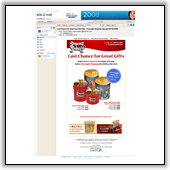 AOL Mail | 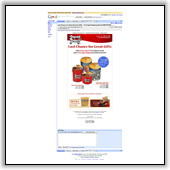 Gmail |
 Microsoft Outlook 2007 | 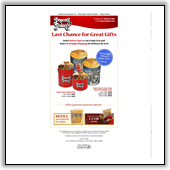 Windows Mail |
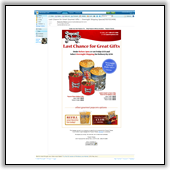 Hotmail | 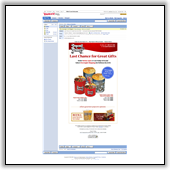 Yahoo! Mail |
 Mozilla Thunderbird | |
Noteworthy:
JangoMail is the only Email Service Provider to a) develop this feature from scratch and b) provide this feature free-of-charge to all users. A few of our competitors that have this feature license the technology from third parties and charge for it on a per-incident basis.
Monday, December 24, 2007
Encouraging the use of DomainKeys
To help ensure optimal deliverability to Yahoo! addresses, we are strongly encouraging all clients who use a non-jangomail.com From Address to ensure that their email messages are signed with DomainKeys. If you send from your @jangomail.com address, your messages are already DomainKeys signed. If you send from your own email address, then you need to setup JangoMail to sign messages for your domain.
Instructions on setting up DomainKeys can be found in this JangoMail DomainKeys Tutorial.
This week we will proactively be sending emails to those clients that send non-DomainKeys signed emails in order to encourage them to set up DomainKeys.
Instructions on setting up DomainKeys can be found in this JangoMail DomainKeys Tutorial.
This week we will proactively be sending emails to those clients that send non-DomainKeys signed emails in order to encourage them to set up DomainKeys.
Saturday, December 22, 2007
JangoMail sets up Comcast Feedback Loop
JangoMail has joined the Comcast Feedback Loop as of this afternoon. Now any Comcast.net users that report e-mailings from JangoMail as spam, will automatically have their e-mail addresses placed on the specific customer account's unsubscribe list. This will improve JangoMail's overall reputation with and deliverability to comcast.net e-mail addresses!
Friday, December 21, 2007
"View as a Web Page" now supports personalization
Many customers have asked for this recently. Now, when you insert a "View as a web page" link into your HTML e-mails, if you're using personalization syntax within the HTML e-mail, that personalization will now properly render in the web page. Previously, the "View as a web page" feature did not show personalization and instead showed the percentage / field name syntax (example: %%FirstName%%).
To insert a "View as a web page" link into your e-mail, you simply insert this code into the body of your HTML message:
Alternatively, if you're using the Enhanced HTML Editor, you can simply click the "Web" button to dynamically insert a "View as a web page" link wherever the cursor is. To learn more about personalization syntax in your e-mail messages, see this tutorial.
To insert a "View as a web page" link into your e-mail, you simply insert this code into the body of your HTML message:
Click <A HREF="http://x.jngo1.net/w.z?***uniqueid****">here</a> to view this e-mail as a web page.
Alternatively, if you're using the Enhanced HTML Editor, you can simply click the "Web" button to dynamically insert a "View as a web page" link wherever the cursor is. To learn more about personalization syntax in your e-mail messages, see this tutorial.
Thursday, December 13, 2007
New Bounce Handling Rules
We have enhanced the way JangoMail handles bounces to improve overall system deliverability. Many of the top ISPs like Hotmail, Yahoo, AOL, GMail, and others have recently mandated that if an e-mail address bounces even once indicating that the mailbox doesn't exist, email marketers should cease mailing to that e-mail address immediately in order to ensure optimal email deliverability.
In conjunction with this, if a Bounce indicates that the mailbox does not exist, JangoMail will stop sending to this address from your account regardless of what numeric setting you have specified under My Options --> Bounce Handling.
However, if a Bounce indicates a temporary failure for that email address, then the numeric setting under My Options --> Bounce Handling will still apply.
Additionally the new Bounce handling mechanism will allow you to see the Bounce reasons for the life of your account rather than just for 7 days, once the enhanced Reporting module is in place (about six weeks from now).
Here are some examples to illustrate the new Bounce handling:
A bounce with a message like:
smtp;550 4.2.1 mailbox temporarily disabled: akidd4@verizon.net
is a temporary failure, and the setting under My Options --> Bounce Handling would apply.
A bounce with a message like:
smtp;550 No such user here
indicates that the mailbox does not exist at all, so a single bounce would prevent JangoMail from sending to this address in the future.
In conjunction with this, if a Bounce indicates that the mailbox does not exist, JangoMail will stop sending to this address from your account regardless of what numeric setting you have specified under My Options --> Bounce Handling.
However, if a Bounce indicates a temporary failure for that email address, then the numeric setting under My Options --> Bounce Handling will still apply.
Additionally the new Bounce handling mechanism will allow you to see the Bounce reasons for the life of your account rather than just for 7 days, once the enhanced Reporting module is in place (about six weeks from now).
Here are some examples to illustrate the new Bounce handling:
A bounce with a message like:
smtp;550 4.2.1 mailbox temporarily disabled: akidd4@verizon.net
is a temporary failure, and the setting under My Options --> Bounce Handling would apply.
A bounce with a message like:
smtp;550
indicates that the mailbox does not exist at all, so a single bounce would prevent JangoMail from sending to this address in the future.
Thursday, November 08, 2007
New Feature: Blocking sign-up form spam by specifying an Exclusive Referrer URL
In the past, we outlined a method to block sign-up form spam by changing the encoding type of your sign-up form. That method may be found here.
This method will not work, however, in cases where the spambot isn't coming through your web site's form but rather by avoiding a form alltogether and programatically doing a FORM POST to our form processor file, http://www.jangomail.com/APPLICATION/PGSF2.asp or http://www.jangomail.com/APPLICATION/PGSF2ENC.asp.
To defend against this new technique for propagating sign-up form spam, you can now specify an exclusive Referrer URL from where the signup form must originate. You can now assign a specific exclusive Referrer URL to a particular JangoMail Group. Then, if a form signup comes from a destination other than the exclusive Referrer URL you have designated, the signup will not be processed.
Currently there is no interface within JangoMail for you to be able to set an exclusive Referrer URL yourself for an e-mail Group. Currently, our support team must do this for you administratively should you wish to take advantage of this setting.
This method will not work, however, in cases where the spambot isn't coming through your web site's form but rather by avoiding a form alltogether and programatically doing a FORM POST to our form processor file, http://www.jangomail.com/APPLICATION/PGSF2.asp or http://www.jangomail.com/APPLICATION/PGSF2ENC.asp.
To defend against this new technique for propagating sign-up form spam, you can now specify an exclusive Referrer URL from where the signup form must originate. You can now assign a specific exclusive Referrer URL to a particular JangoMail Group. Then, if a form signup comes from a destination other than the exclusive Referrer URL you have designated, the signup will not be processed.
Currently there is no interface within JangoMail for you to be able to set an exclusive Referrer URL yourself for an e-mail Group. Currently, our support team must do this for you administratively should you wish to take advantage of this setting.
Tuesday, November 06, 2007
New Feature: Generating a Plain Text Message Automatically at Run-Time
You can now have JangoMail automatically generate a Plain Text version of your e-mail message, based on your HTML version, at the time the email message is sent (run-time). To do this, set your Plain Text message to the word "auto-generate".
There has always been the "Set Plain Text Automatically" button underneath the Plain Text Message field on the Send Email page. This button examines your HTML message and generates a Plain Text Message for you right before your eyes. However, there may be situations where you don't want to generate the Plain Text message right away but rather have the Plain Text message generated at the time the email message is actually sent.
There are 3 scenarios where this feature will be advantageous.
Scenario 1 - Embedded URLs
If you are using Embedded URLs within your e-mail message, your HTML message might look like:
<html>
<p>
Hello there. Below you will find today's mutual fund prices:
</p>
[%%http://www.MutualFundCompany.com/Prices.aspx%%]
<p>
Thank you for investing in our mutual funds.
</p>
</html>
By setting the Plain Text Message field to "auto-generate", the following will take place at the time of e-mail sending:
- JangoMail will retrieve the HTML content from the specified URL.
- JangoMail will insert the HTML content into the HTML message.
- JangoMail will generate a Plain Text version of the e-mail message based on the complete HTML message.
In this scenario, if you do NOT set the Plain Text field to "auto-generate", but instead use the "Set Plain Text Automatically" button on the Send E-mail page, the following will take place:
- The Plain Text version will look like this:
Hello there. Below you will find today's mutual fund prices.
[%%http://www.MutualFundCompany.com/Prices.aspx%%]
Thank you for investing in our mutual funds.
- When JangoMail retrieves the HTML content from the URL, the Plain Text message will now contain HTML code, and we don't want that to happen!
Scenario 2 - Using the Web Service/API
When calling any of these methods:
SendMassEmail
SendMassEmailPrevious
SendMassEmailRaw
Setting the MessagePlain input parameter to "auto-generate" will allow JangoMail to generate a Plain Text version of your HTML e-mail for you automatically. The "Set Plain Text Automatically" button that is available in the JangoMail web interface is not available when using the API, so for any automatic conversion to take place, the MessagePlain input parameter must be set to "auto-generate". Otherwise, you would have to manually input a Plain Text version of your message.
Scenario 3 - Using Conditional Logic Statements
When using VBScript conditional logic statements in your e-mail message, the line spacing of plain text messages can be altered based on where you place your lines of code. These spacing issues can be avoided by setting the Plain Text field to "auto-generate" rather than placing actual conditional logic statements within the Plain Text field.
Feature Enhancement: Using wildcards when filtering a Group based on clicks
When filtering a Group by those that have clicked on a particular URL, you can now use wildcards in the URL.
For example, in the Advanced Filter Mode, the filter criteria based on a clicked URL would normally look like:
emailaddress in (##clicked-http://www.jangomail.com/pricing.asp##)
but now you can filter for anyone that has clicked on any URL that contains jangomail.com:
emailaddress in (##clicked-*jangomail.com*##)
This feature was added at the request of an evaluating customer.
For example, in the Advanced Filter Mode, the filter criteria based on a clicked URL would normally look like:
emailaddress in (##clicked-http://www.jangomail.com/pricing.asp##)
but now you can filter for anyone that has clicked on any URL that contains jangomail.com:
emailaddress in (##clicked-*jangomail.com*##)
This feature was added at the request of an evaluating customer.
Sunday, November 04, 2007
Bug Fix: Sending a Campaign where Recipient Group has been DELETED
We have fixed a bug tonight that caused a campaign to completely fail if one of the recipient Groups had been deleted between the time of creating the campaign and the time of campaign sending.
NOW, if a campaign includes a Group that has been deleted, the campaign will still send to all other present Groups and will gracefully skip over the Group that has been deleted.
NOW, if a campaign includes a Group that has been deleted, the campaign will still send to all other present Groups and will gracefully skip over the Group that has been deleted.
New Feature: Large Text Fields in Groups
When managing fields in your Groups, you now have the ability to create a special type of field which allows for storage of a large amount of text data.
Previously:
Previously:
- Fields in Groups could store a maximum of 8,000 characters
- The total amount of personalization amongst all fields within any single e-mail campaign could not exceed 7,900 characters.
- A "large text" field in a Group can now store virtually an unlimited number of characters.
- There is no limit to the amount of personalization within an e-mail campaign.
- Within your Group, click on "Modify Fields in Group".
- You can add a new Group field that stores large text by choosing a name for the field and checking the box labeled "Will store large text data".
- You can convert an existing field by clicking the "Convert" button next to the existing field.
- If using the API, use the AddGroupField_Big method instead of the regular AddGroupField.
Subscribe to:
Posts (Atom)